The miroir d'eau Bordeaux is one of those places you visit once as a tourist and keep coming back to, for years, without ever getting tired of it. I have been there with students, with my children, with my dogs, sometimes all at once. And every single time, something happens that makes the French lesson feel like the most natural thing in the world.
Learn French in the Wild
At French in Bordeaux, we believe French is easier to remember when it is connected to real places, real movement and real conversations. The miroir d’eau is not just a beautiful landmark: it becomes a living classroom.
You observe, describe, compare, ask questions and react to what is happening around you. That is how French stops being an exercise and becomes part of everyday life.

What is the miroir d'eau de Bordeaux?
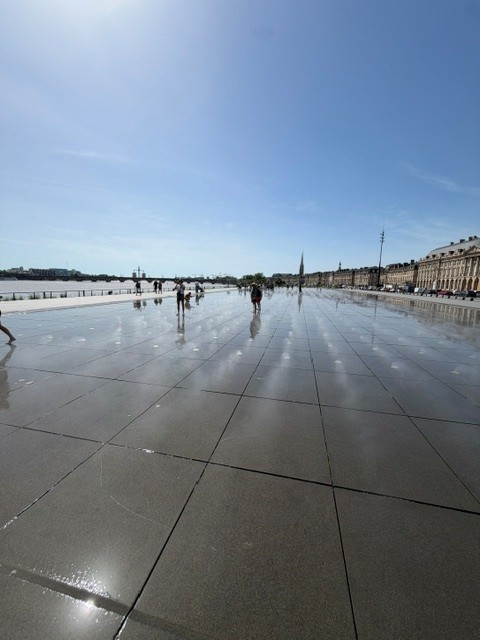
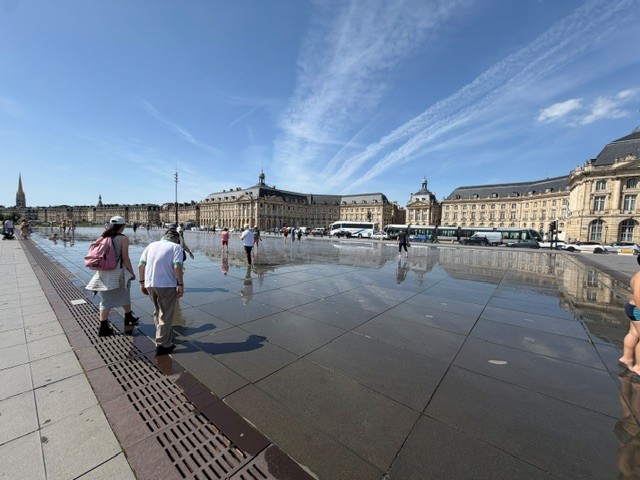
Opened in 2006, the miroir d’eau is the largest reflecting pool in the world: 3,450 square metres of polished granite covered by just two centimetres of water. It sits on the Quais de la Garonne, directly opposite the Place de la Bourse, one of Bordeaux’s most iconic 18th-century squares. The reflection it creates is extraordinary: the classical stone façade, the sky, the tram gliding past, all of it reproduced perfectly on the surface of the water.
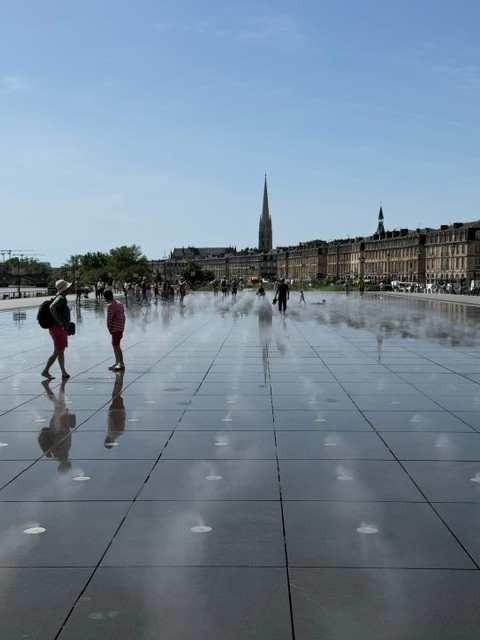
Designed by landscape architect Michel Corajoud, the pool alternates between two states: a still mirror effect, then a mist rising from the granite. The cycle repeats throughout the day when the installation is operating. Children run through the fog. Adults stand at the edge and watch. Dogs, when allowed, investigate the situation very carefully.
Why I bring my students here
Learning French in a classroom works. Learning French while walking along the Garonne, stopping at the miroir d’eau, watching people, describing what you see: that works differently. It sticks.
This is the core idea behind our Walk & Talk French lessons in Bordeaux. We take the lesson outside. The city becomes the classroom. And the miroir d’eau is one of the best settings we have: it is free, it is open to everyone, it is visually rich, and it generates conversation naturally.
For beginners, it helps connect simple French words to real objects, movements and sensations. For intermediate learners, it opens the door to richer descriptions, opinions, comparisons and cultural discussion. You are not just memorising vocabulary. You are using it immediately, in context.
Useful French words at the miroir d’eau
Standing there, you practise vocabulary you will actually use. The words are not abstract anymore: you can see them, hear them, feel them and use them immediately.
- le reflet — the reflection
- le brouillard — the mist / fog
- la pierre — the stone
- le fleuve — the river
- les quais — the riverbanks
- marcher — to walk
- observer — to observe
- décrire — to describe
You describe what you see, what you feel, what changes from one moment to the next. It is observational language, real and immediate.
We also talk about the city itself. The Place de la Bourse was commissioned by Louis XV in the 18th century and designed by royal architect Jacques Gabriel. The miroir d’eau came more than two centuries later, as part of the major transformation of the left bank of the Garonne. Two eras, one dialogue. That is Bordeaux in a nutshell, and in French, it is a wonderful conversation to have.
Children, dogs, and the fog machine
I will be honest: I have not always come here strictly for professional reasons. My children discovered the mist cycle very early and treated the whole thing as a personal water park. My dogs have their own relationship with those two centimetres of water: let’s say they are thorough investigators.
This is also what makes the miroir d’eau special as a language learning environment. It is a living place, not a monument you observe from a distance. There are families, locals, tourists, students, dogs, pigeons, and the occasional very elegant older gentleman reading a newspaper on a bench nearby, completely unbothered by all of it.
Real life, in real French.
Practical information
The miroir d’eau is free and is usually in operation outside the winter period, generally from 10am to 10pm. It normally closes during the colder months for maintenance and to protect the system from frost. Before planning a specific visit, it is always worth checking current local information, especially in winter or during maintenance periods.
The best time to visit for the mist effect is on a warm afternoon, when the contrast between the cool fog and the heat of the granite is at its most dramatic. Evening is also beautiful, especially when the Place de la Bourse begins to light up and the reflection becomes more theatrical.
It is easily reached by tram: line C, stop Place de la Bourse. From Darwin Éco-système, where many of our lessons take place, it is a short tram ride across the river, or a very pleasant walk across the Pont de Pierre.
Learn French in Bordeaux, outside the classroom
If you want to learn French in Bordeaux while actually experiencing the city, our Walk & Talk sessions are designed for exactly that. We use Bordeaux as our material: its architecture, its streets, its people, its rhythms, its riverbanks and its unexpected conversations.
The miroir d’eau is one of our favourite stops, not because it is on every tourist list, but because it works. It gives learners something to observe, describe, compare and remember. It turns French into a direct experience rather than an abstract exercise.
Ready to learn French in Bordeaux, in the wild?
You can explore our French courses in Bordeaux, find out more about how we teach on our About page, or get in touch directly to talk about the format that suits you best.
Come on a warm afternoon. The fog will do the rest.