Your year as
an au pair in Bordeaux
French classes that fit the family schedule, the visa certificate you need, and a genuine welcome in Bordeaux.
Morning lessons at Darwin Éco-système, no classes on Wednesdays, a free enrolment certificate for your visa and a module on speaking French with children.
Your visa and your French classes
The au pair status rests on one principle: you come to France to learn French first. Whether you are a jeune au pair from outside the EU or a stagiaire aide familial with an EU passport, enrolling in French language or civilisation classes is compulsory, and it is part of what makes your visa possible.
In practice, you and your host family sign an au pair placement agreement before you leave. That agreement is filed with the French authorities, and your enrolment certificate goes with it. Without the certificate, the file cannot move forward.
Where the French rules say this
The obligation to attend French classes is set out by the French administration. You can check it directly on the official government sites:
- service-public.gouv.fr – Stagiaire aide familial étranger et jeune au pair (states the requirement to be enrolled in French classes for foreigners)
- service-public.gouv.fr – Salarié au pair (the au pair employment framework)
- france-visas.gouv.fr – Jeune au pair (the official visa portal, with the documents your consulate expects)
A certificate in your name
Weekly hours, start and end dates, level, and the stamp of Glotte Trotters, our Qualiopi-certified training organisation. You receive the PDF within 48 hours, and the original by post if your consulate asks for it. It is free of charge. More about our school and how we work.
Hours that fit the family
French law caps your tasks at 25 hours a week and 5 hours a day, and asks that your schedule leaves room for your classes. Ours run in the morning, between the school run and the afternoon pick-up.
Monthly attendance letters
If your family or the préfecture wants proof that you are attending, we issue an attendance certificate every month, free, on request.
The au pair status, explained
There is a lot of advice online about being an au pair in France, and much of it is vague or out of date. Here is what the French rules actually say, and what each one means for your week.
Jeune au pair or stagiaire aide familial: which one are you?
It depends on your passport. If you hold a passport from an EU or EEA country, you are a stagiaire aide familial étranger: you come to France to study, you are hosted by a family, and you do not need a visa to enter. If you come from outside the EU, you are a jeune au pair: you come to deepen your French and your knowledge of France, and you need a long-stay visa obtained before you travel. The daily reality is identical in both cases. You live with the family, you help with the children and the light housework connected to them, you receive pocket money rather than a wage, and you must be enrolled in French classes. Only the paperwork differs. The official position is published on service-public.gouv.fr.
How many hours can your host family ask of you?
Twenty-five hours a week is the ceiling, and five hours in any single day. You are entitled to one full day off every week, including at least one Sunday a month. There is a fourth rule that matters just as much and is often forgotten: your working hours must be arranged so that you can attend the classes you are enrolled in. Legally, it is the family schedule that makes room for the course. In practice, the tension is about the shape of the day: school run in the morning, pick-up in the late afternoon, and Wednesday, when many French primary schools close. That is exactly why our classes sit between 9:30 and 12:30, and never on a Wednesday.
What you receive, and what you do not
You get your own room in the family home, three meals a day, and monthly pocket money set by the regulation rather than negotiated freely. You pay no rent. You are declared to URSSAF by your host family under the stagiaire aide familial scheme, which is what gives you health cover. Check in your first fortnight that the declaration has actually been made, because a late one leaves you uninsured. What you do not get is a salary, and the distinction is deliberate: your status exists for cultural and linguistic exchange, not employment. That is also why the hours are capped and why the classes are compulsory rather than optional.
When the family and the agency disagree with each other
It happens more often than you might expect. The agency promises one schedule, the family has another in mind, and you find out once you arrive. Your protection is the placement agreement you both signed: hours, tasks, pocket money and French classes are written into it, and it was filed with the French authorities. Bring the timetable on this page to the conversation before you arrive. It shows a real week, with class time, family time and free time side by side, and it turns an awkward negotiation into a practical one.
Your week as an au pair
Pick your course below to see how the mornings fall across a real week. Every version keeps Wednesday free.
Visa 6h: two mornings on site, Monday and Friday, plus 30 minutes of online culture work four days a week. Tuesday, Wednesday and Thursday stay clear for the family.
Visa 12h: four full mornings on site, Monday, Tuesday, Thursday and Friday, 9:30 to 12:30. Twelve hours a week, alongside our international students. Wednesday stays free.
| Mon | Tue | Wed | Thu | Fri | |
|---|---|---|---|---|---|
| 7:30 – 9:00 | Family | Family | Free | Family | Family |
| 9:30 – 11:3012:30 | French class | French class | Family | French class | French class |
| 1:00 – 4:00 | Free | Free | Family | Free | Free |
| 4:30 – 6:30 | Family | Family | Family | Family | Family |
Plus 30 minutes online, four days a week. A short culture and civilisation session on our learning platform, with practical background on France and the places worth visiting around Bordeaux. Do it on the tram, during the children's nap, or on a Sunday morning. It counts towards your six hours.
Twelve hours a week, the same volume as the biggest schools in Bordeaux, at the same price. There is nothing on top: no enrolment fee and no paperwork charge for your visa certificate. You join our international group rather than an au pair-only class, so you practise with students from a dozen countries every morning. The online culture track and the module on working with children are included.
Wednesday is free, always. French primary schools often close on Wednesdays, so that is the day your family needs you most. We never schedule classes then, and never during French school holidays either. On this example week you stay well under the 25-hour cap, and never more than 5 hours in a single day.
Two things you will not find elsewhere
Talking with children
Created with Trotters Training, our own apprenticeship centre for early childhood professionals. You get the vocabulary that comes up every day with young children, from meals and bath time to homework and bedtime, plus a bank of activities you can run with them in French, English or Spanish. It makes your first weeks with the family much easier, and it is the part host families notice.
France, 30 minutes a day
A daily culture and civilisation session on our online platform. Practical, historical and cultural background on the country you are living in, and a running list of places to visit around Bordeaux and the region, with what to know before you go. It counts towards your hours on Visa 6h, and comes free on top of Visa 12h.
One price, nothing added
Most schools bill an enrolment fee on top, and several charge again for the pre-enrolment certificate your consulate needs. We charge neither. Materials, level certificate, monthly attendance letters and our cultural outings are all in the price you see.
- ✔ Enrolment certificate for your visa: free, no paperwork charge
- ✔ Monthly attendance certificates: free, on request
- ✔ No enrolment fee, no membership fee, no hidden costs
- ✔ Learning materials and level certificate included
- ✔ Monthly cultural activities included
- ✔ No classes on Wednesdays or during French school holidays
- ✔ Start any Monday if you already have some French, with monthly intakes for complete beginners
What French courses for au pairs in Bordeaux cost
Prices are per person and all-inclusive: no enrolment fee, no membership fee, no hidden costs. A cycle is 10 teaching weeks, spread around the French school holidays. You can chain cycles for as long as your stay lasts.
| Course | Level | Schedule | Format | 1 cycle (10 weeks) | 3 cycles (30 weeks) |
|---|---|---|---|---|---|
| Visa 6h ↓ | A1 – B2 | 2 × 2h on-site, Mon & Fri, 9:30 – 11:30 + 4 × 30 min online |
Small group | 480 € | 1 290 € |
| Visa 12h ↓ | A1 – B2 | 4 × 3h on-site Mon, Tue, Thu & Fri, 9:30 – 12:30 |
International group | 740 € | 1 990 € |
| Enrolment fee | Including your visa certificate and monthly attendance letters | 0 € | 0 € | ||
| Talking with children (10h) | Developed with Trotters Training, our early childhood apprenticeship centre | Free | Free | ||
| Private top-up → | All levels | Flexible, 90 minutes minimum | 1 student | 45 € / hour | |
Personal expenses during outdoor activities, such as drinks, entrance tickets or transport, are not included. Need evening classes or a different rhythm? Look at our Tailor-made programme.
Visa 6h
Two mornings a week on site, Monday and Friday, plus half an hour of online culture work on four days. Six hours in total, the volume most consulates accept, on a schedule that leaves Tuesday, Wednesday and Thursday clear for the family, for the city and for rest.
You learn in a small international group, with au pairs who arrived the same month. Grammar and vocabulary are covered properly, and the priority is speaking: ordering, explaining, asking questions and joining in, the French you need at the family table on your first Sunday.
- When
- 9:30 – 11:30
Mon & Fri - Schedule
- 4h on-site + 2h online
10 teaching weeks - Format
- Small group
all nationalities - Price
- 480 € / cycle
1 290 € for 3 cycles
Visa 12h
Four full mornings on site, Monday, Tuesday, Thursday and Friday, from 9:30 to 12:30. Twelve hours a week, 120 hours over the cycle: the same volume and the same price as the largest French schools in Bordeaux, with no enrolment fee and no charge for your visa certificate.
You are not in an au pair bubble here. You join our international group, with students from a dozen countries who came to Bordeaux for the same reason you did. It is the difference between understanding French and living in it, and many students on this course sit a DELF exam before going home, leaving with a French state diploma that never expires.
Minimum commitment of one 10-week cycle.
- When
- 9:30 – 12:30
Mon, Tue, Thu & Fri - Schedule
- 12h / week on site
10 teaching weeks - Format
- International group
all nationalities - Price
- 740 € / cycle
1 990 € for 3 cycles
Bring the lesson home
Most host families end up paying for their au pair's French course. Here is what you get when you do it with us, and why it costs far less than the headline price suggests. If the whole family wants to learn together, our French for families programme is built exactly for that.
A teacher comes to your home for two hours and works with your au pair and your children together, in French, around a game, a recipe, a story or a craft. Your au pair learns to run the activity again on her own for the rest of the week, your children get a real French session at home, and nobody has to travel.
60 € an hour, 30 € after tax credit
Home tuition is a declared service à la personne, invoiced by Alumninéo, our home-tuition arm. You claim 50% back under article 199 sexdecies. There is no income condition, and it works even if you pay no income tax. Minimum two consecutive hours per visit.
English and Spanish for your children
Your children get free access to Talking Talking, our online English and Spanish platform for kids, for as long as your au pair studies with us, plus a bank of games and activities she can run with them in English or Spanish.
An au pair who knows what to do
The ten-hour module we created with Trotters Training, our early childhood apprenticeship centre, gives her the vocabulary and the activity ideas before she arrives. It is the difference between an au pair who supervises and one who plays with your children in French.
| Family package, one cycle (10 weeks) | Invoiced | Tax credit | Real cost to you |
|---|---|---|---|
| Visa 6h group course at Darwin | 480 € | – | 480 € |
| Home workshop, 2h every fortnight, 5 visits | 600 € | − 300 € | 300 € |
| Home workshop, 2h every week, 10 visits | 1 200 € | − 600 € | 600 € |
| Talking Talking access for your children | Free | – | Free |
| Working-with-children module for your au pair | Free | – | Free |
The tax credit applies to the home workshop only, because it is delivered in person at your residence. Group classes and online content are not eligible, and we will not put them on a home-tuition invoice. Payment must be traceable, by transfer, cheque or card. You receive your annual tax certificate before 31 March. Ask us about the URSSAF immediate advance, which lets you pay only half at the time. Tax credit eligibility depends on your situation and current French rules; we recommend confirming the details with us or your tax adviser before you commit.
How far 10, 20 or 30 weeks takes you
Progress depends a lot on you, so most schools stay vague about it. Here is a straight answer anyway, based on what au pairs in our groups typically reach when they attend regularly and speak French at home rather than English.
One cycle: arriving with nothing, leaving with A1
Ten weeks from zero puts you at a solid A1. In practice, you order in a café without rehearsing, you understand the children when they ask for something, you follow a family conversation even when you lose some of the details, and you can explain what you did yesterday. You still translate in your head, and phone calls are still hard. That last point matters more than it sounds. Most au pairs plateau at A1 because the family switches to English out of kindness. Ask them not to, on day one, before the habit forms.
Two cycles: A2, the level where life gets easier
Twenty weeks is where the change becomes visible to everyone around you. At A2 you handle the doctor, the pharmacy, the bank appointment and the parents at the school gate. You hold a real conversation, and you start to understand jokes soon after everyone else. A2 is also the level most au pairs need if they intend to stay in France afterwards, for a student visa, a first job application, or simply to take a full part in daily life.
Three cycles: B1, and a diploma worth taking home
Thirty weeks of steady work, plus a year of living in French, reliably produces B1. You follow a film without subtitles, you hold your own in a group where nobody slows down for you, and you write a coherent email. This is the point to sit the DELF B1. It is a French state diploma, recognised worldwide, and it never expires. Ten months in a French family is a real investment of your time, and leaving with an official document that proves what you achieved is worth the extra effort.
Why we push speaking before grammar
Your grammar will be corrected for a year by young children, which is about the most patient teaching environment there is. The classroom gives you what you cannot get at home: structured input, feedback from a professional teacher, and other adults at your level who are learning alongside you. So our mornings run on discussion, role play, real documents and correction in context, with grammar introduced when it answers a question you have already met in practice. This can feel slower at first, but it produces French you actually keep.
From your country to your first lesson
You find your host family
Through an agency or a matching platform. Together you sign the au pair placement agreement, which sets out your tasks, your hours, your pocket money and your French classes.
You take our level test
Online, 25 minutes, free. It decides which group you join, and whether you start on the next Monday or at the next beginner intake. Complete beginner is not a problem. We open an A1 group every month, all year round.
We issue your enrolment certificate
In your name, with your weekly hours, your dates and the stamp of Glotte Trotters, our Qualiopi-certified organisation. PDF within 48 hours, original by post if your consulate requires one. No charge.
You apply for your visa
At the French consulate in your country, with the placement agreement and our certificate. If the administration has questions, we answer them directly, so your host family does not have to guess.
You arrive, and you start
You meet your group, get your platform login and your childcare module, and speak French from the first hour. Your cycle runs 10 weeks, and you can chain another one for as long as your stay lasts.
Life as an au pair in Bordeaux
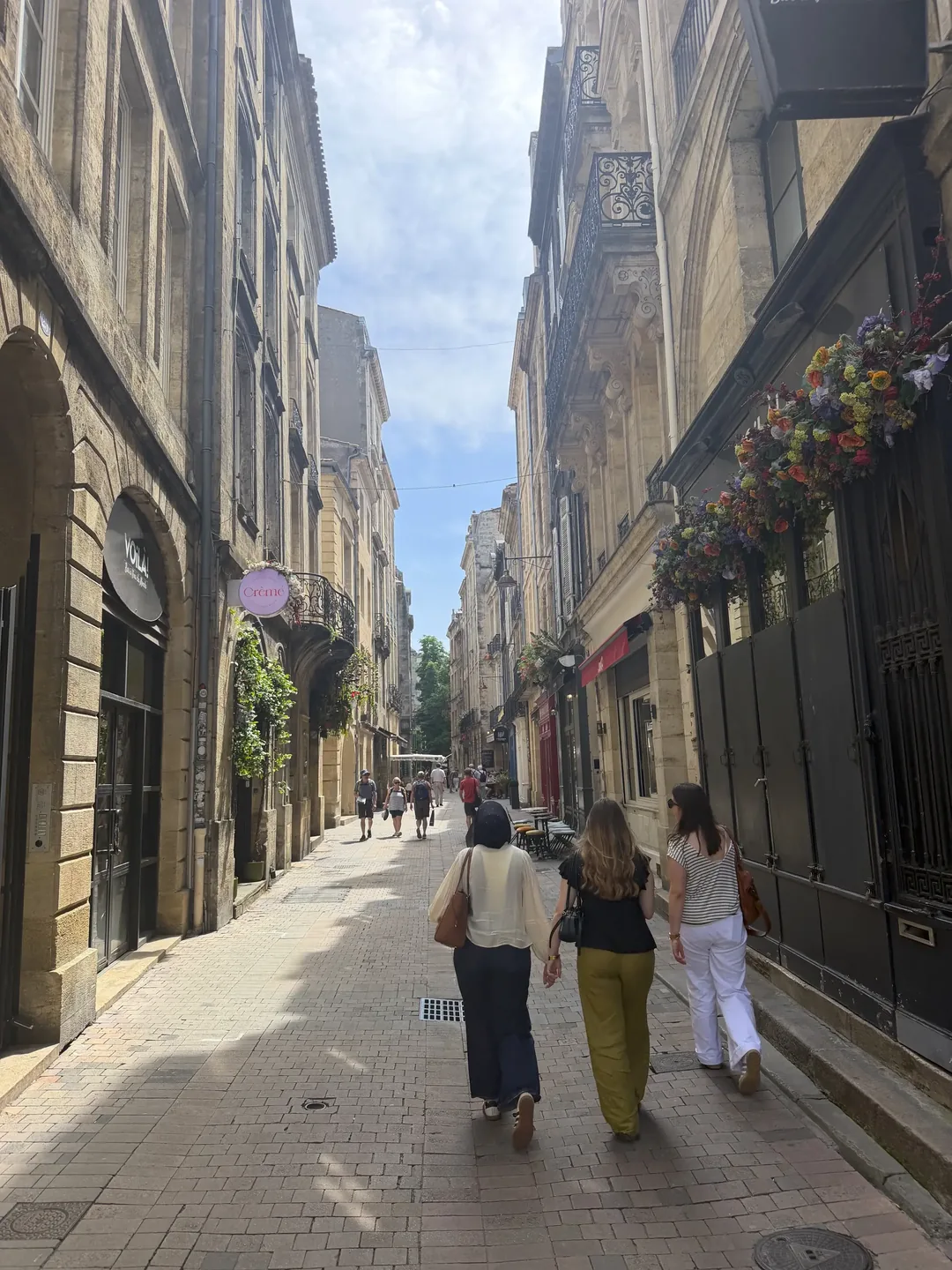
Bordeaux is a city you can cross by tram or bike, small enough that you start recognising faces at the Marché des Capucins after a month. That matters a lot when you arrive on your own.
Classes take place at Darwin Éco-système, on the right bank of the Garonne, a former military barracks turned into cafés, workshops and skate ramps. You practise French the moment you step out of the room.
Our groups bring together au pairs from across Europe and Latin America who arrived exactly like you. Most friendships start in the Monday morning class and continue at our monthly cultural activities: markets, wine villages, French-language cinema, and the beach at Cap Ferret when the weather allows.
- ✔ Free afternoons, when the city is actually open
- ✔ Wednesdays kept clear for your family
- ✔ Monthly outings included with every course
- ✔ A concierge service if you need help settling in
- ✔ 30+ nationalities since 2015
Getting to Darwin from where your family lives
Darwin sits on the right bank, at the Bordeaux end of the Pont de Pierre. From the left bank it is a short tram ride plus a walk, or ten minutes by bike across the bridge. From the suburbs where most host families live, such as Caudéran, Le Bouscat, Talence, Mérignac and Bègles, count 30 to 40 minutes door to door on public transport. Buy a monthly TBM pass in your first week; the reduced rate for under-28s makes it one of the cheapest transport passes in France.
Meeting people when you arrive alone
This is the hard part, and it is easy to underestimate. You arrive in a house that already has its routines, you are neither family nor employee, and the children go to bed early. Your class is the fastest answer: the same faces four mornings a week, all of them new here too. Our monthly cultural outings exist partly for this reason: an excuse to spend a Saturday with people who understand exactly what your week looks like.
What to do on your day off
Saint-Émilion and the Médoc are under an hour away by train or car. Arcachon and the Dune du Pilat take about an hour. Bayonne, Biarritz and the Spanish border are two hours on the TGV, and Toulouse is two hours the other way. Closer in: the Sunday market on the quays, the Bassins des Lumières, the Jardin Public, and Darwin itself at the weekend.
Questions au pairs ask us
How many hours of French do I need each week as an au pair in France?
French law requires you to be enrolled in language or civilisation classes, without fixing a single figure. In practice, consulates and préfectures usually expect between 6 and 12 hours a week. Visa 6h covers most files, and Visa 12h covers the higher requirements while giving you the volume the biggest schools advertise.
I arrive in November. Do I have to wait for a new term?
No. Cycles run continuously all year, so if you already have some French you can join on any Monday and your 10 weeks start from there. Complete beginners join at the monthly A1 intake. You do not have to wait for September or January.
Who pays for the French classes, me or my host family?
It is negotiated before you leave and written into your placement agreement. Many host families pay for the classes, in full or in part. Raise it clearly during your first conversations. It is a normal part of the discussion, not a favour. We can send a quote directly to your family if that helps.
Can my host family claim a tax credit on my French course?
On the group course at Darwin, no. French tax rules only allow the credit for services delivered in person at the taxpayer's home, and classes at a training centre or online do not qualify. On the home workshop, yes: it is a declared service à la personne, so your family claims 50% back, which brings 60 € an hour down to 30 €.
I do not speak any French yet. Can I still enrol?
Yes, and at any time of year. We open an A1 complete beginner group every month, so you never wait more than a few weeks. Classes run in French from day one, with teachers trained to work with real beginners.
Is the enrolment certificate enough to get my visa?
It is one piece of the file, not the whole of it. Your application also includes the au pair placement agreement validated by the French authorities, your passport and the documents your consulate lists. Our certificate covers the French classes part.
Can I take the course if my host family lives outside Bordeaux?
Yes, if you can reach Darwin for 9:30. Most of Bordeaux Métropole is within 40 minutes by tram and bus, and that covers the communes where the great majority of host families live. Further out, in places like Libourne, Arcachon or Langon, the commute becomes the deciding factor, and Visa 6h with its two mornings is usually the realistic option. Tell us where the family lives and we will tell you honestly whether it works.
What happens if my placement ends early?
It happens, and it is rarely anyone's fault. If you change host family within Bordeaux, nothing changes for you here: your enrolment continues and we reissue any certificate the new family or the préfecture needs. If you leave France before your cycle ends, tell us as early as you can and we will work out what is fair.
Do you help with the paperwork once I have arrived?
With the part that concerns your studies, yes: enrolment certificates, attendance letters, level certificates, and answering the administration directly when they query your course. For the rest, such as visa validation, the residence permit and the URSSAF declaration, we point you to the right service rather than guess. Getting that wrong is expensive, and we would rather send you to someone who does it every day.
Where do the classes take place?
At Darwin Éco-système, on the right bank of Bordeaux, reachable by tram and bike from most of the city. Some sessions happen out in Bordeaux itself. Our administration is based in Mérignac.
Do I leave with a diploma?
You receive a level certificate at the end of each term. For an official, permanent qualification, prepare the DELF exam, a French state diploma recognised worldwide, with no expiry date.