In April 2025, this Erasmus+ Bordeaux programme welcomed around fifteen Italian teachers from two secondary schools in Calabria, as part of a mobility exchange.
Their primary objective was to discover French teaching methods through direct classroom observation, what Erasmus+ calls job shadowing. Practising French in real situations and engaging with subjects that go well beyond a standard language course were also part of the programme.
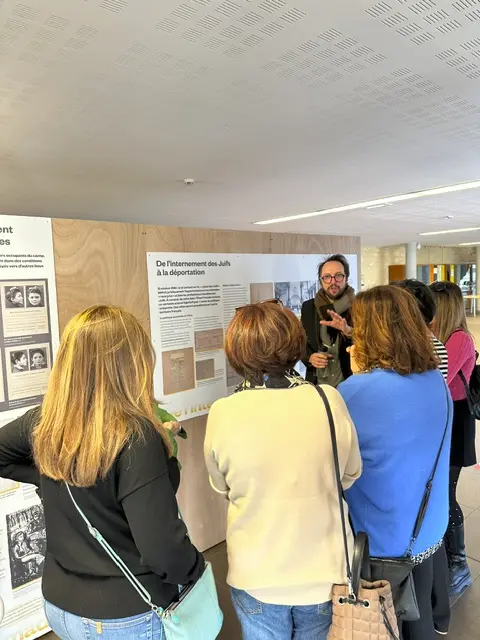
During their stay, we also chose to explore a complex and painful chapter of Bordeaux’s past. Like much of France, Bordeaux lived under German Occupation from 1940 to 1944. That period left deep marks: internment, persecution, deportation. A history the city continues to document and transmit.
What Job Shadowing Offers Teachers
Erasmus+ is often described as a mobility tool, and it is. But for teachers, job shadowing means something more specific: observing colleagues in another country working in real conditions, comparing your own teaching practices with theirs, and returning to your own classroom with an experience no textbook can provide.
Part of the programme took place directly in Bordeaux schools. The Calabrian teachers were able to sit in on ordinary lessons, in Bordeaux classrooms, alongside students and teachers going about their usual work. Nothing had been specially prepared for the occasion.
Those observations then fed into debriefing sessions with the teaching team at Glotte Trotters, the Bordeaux-based training organisation that coordinated the group’s reception and academic supervision. What are the main differences between Italian and French teaching practices? What tools are used on each side? How much space is given to student interaction, to making mistakes, to spontaneous exchange?
These discussions, conducted in French, produced exactly what an Erasmus+ Bordeaux mobility is designed to produce: professional reflection grounded in real experience. For these teachers of French and history, language was a tool for understanding, questioning, reformulating and debating, not an objective disconnected from the reality of the stay.
The programmes designed by Glotte Trotters and French in Bordeaux are not language courses with cultural visits added on. From the outset, they bring together language learning, engagement with a place, and the exchange of professional experience. Find out more about our specialised workshops in Bordeaux.
The Mérignac-Baudésert Internment Camp
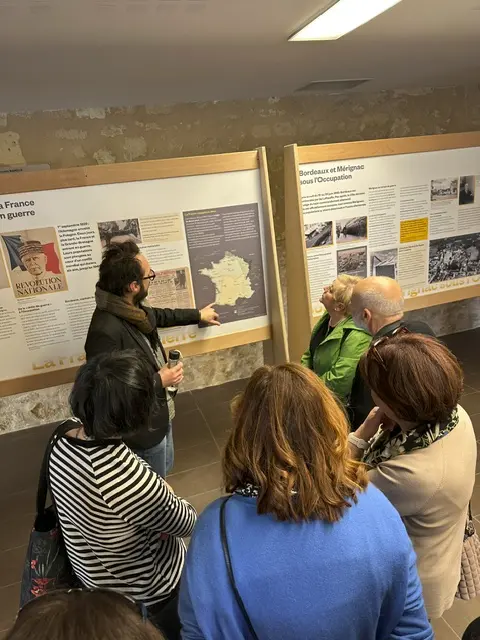
The group visited the Gironde Departmental Archives to see an exhibition on the Mérignac-Baudésert internment camp, which operated between 1940 and 1944 on the outskirts of Bordeaux.
The history of this camp is precise, well-documented and deeply local. For the Jewish people interned there, it often served as a staging point before transfer to Drancy, via Bordeaux Saint-Jean station, and then to the Nazi extermination centres, including Auschwitz.
Aaron Cyrulnik and his wife Nadia were interned there following the roundup of 15 and 16 July 1942. Neither survived deportation.
Their son, Boris Cyrulnik, was born in Bordeaux in 1937. A neuropsychiatrist and author whose work has been translated worldwide, he is one of the best-known French figures on the subjects of trauma and psychological reconstruction. Arrested at the age of six during the roundup of 10 January 1944, he managed to escape from the Bordeaux Synagogue where he had been held. The sole survivor of his family, separated from parents who never returned from deportation, he went on to dedicate much of his work to the processes of recovery after trauma, playing a central role in bringing the concept of resilience to public attention in France, a concept that resonates deeply with his own personal history.
For the Italian teachers, these themes were not unfamiliar. Fascist Italy, the racial laws of 1938, deportation: the historical parallels were there, without needing to be forced. The discussions between the group and the guide unfolded in French, mixing historical vocabulary, precise questions and moments of silence.
The Bordeaux Synagogue
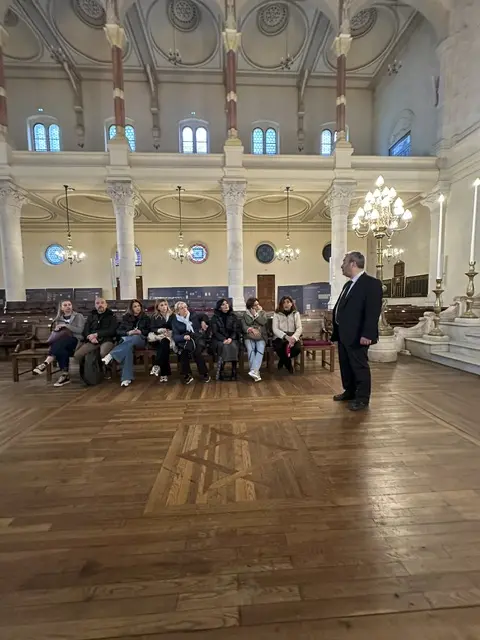
That afternoon, we were welcomed by the rabbi of the Bordeaux Synagogue.
Standing in the very building where the young Boris Cyrulnik had been held before managing to escape gave the day a very concrete dimension. In the morning, we had been to the place where his parents were interned before their deportation. In the afternoon, we were in the synagogue from which he himself had escaped. That thread was not written into the original programme. It was the reality of Bordeaux that imposed it.
The Italian teachers knew the broad outlines of the major French events of the Second World War, just as we know the broad outlines of Italian history during the same period. But the nature of national history is that it leaves us unfamiliar with the details of our neighbours’: the different battles, the individual trajectories, the acts of complicity and local resistance. That is precisely the kind of curiosity the programme made space for.
Inside the synagogue, an exhibition traces the fate of Bordeaux’s Jewish community, including what came after the war: the difficulty many survivors faced in recovering property that had been seized, homes that had been occupied, businesses that had been lost. The post-war period did not erase the injustice. In some cases, it prolonged it.
Questions were asked in French. The rabbi answered with precision and generosity.
What This Experience Says About Our Approach
Bordeaux is known for its heritage, its architecture and its way of life. It also carries a more difficult history, one we want to share through the programmes we build for international groups.
The aim is not to offer something purely academic, but to allow professionals to understand a city in its full complexity, while using the language in a context that carries real meaning. Discover our French cultural activities in Bordeaux.
For teachers, it is also an opportunity to compare the ways in which this history is transmitted. How does France teach this period? What words does it use? How do school programmes address collaboration, roundups, deportation? How are the same subjects taught in Italy? These questions, asked in French between Italian teachers and Bordeaux professionals, are at the heart of what a well-constructed Erasmus+ Bordeaux mobility can produce.
From Language to Transmission
This experience connects directly with the work of Poppies and Daffodils, the association I founded to promote peace education, remembrance and resilience.
French in Bordeaux, working alongside Glotte Trotters, focuses on language learning and engagement with the Bordeaux area. Poppies and Daffodils opens a broader reflection on transmission and reconstruction after conflict. When we welcome European educational projects, the link between the structures becomes natural: history gives language a reason to exist, and language opens the door to history.
Building a Tailor-Made Erasmus+ Programme in Bordeaux
This Erasmus+ Bordeaux account is just one example of the kind of experience we offer to groups of teachers, trainers or learners taking part in a mobility programme.
Depending on the objectives, a programme can include:
- job shadowing sessions in Bordeaux schools;
- pedagogical debriefing sessions;
- targeted French as a Foreign Language courses;
- visits to historical and memorial sites;
- meetings with local organisations and speakers;
- exchanges on the transmission of memory across Europe.
Each programme is built around the objectives of the sending institution and the profile of the participants.
Reception and academic supervision are provided by Glotte Trotters, a Qualiopi-certified training organisation.
You can also discover our French language courses in Bordeaux for all levels and formats.
To discuss a tailor-made programme in Bordeaux: contact us.